Designing a natural ventilation system: How to cool a house without relying on A/C in 2024: what's changed and what works
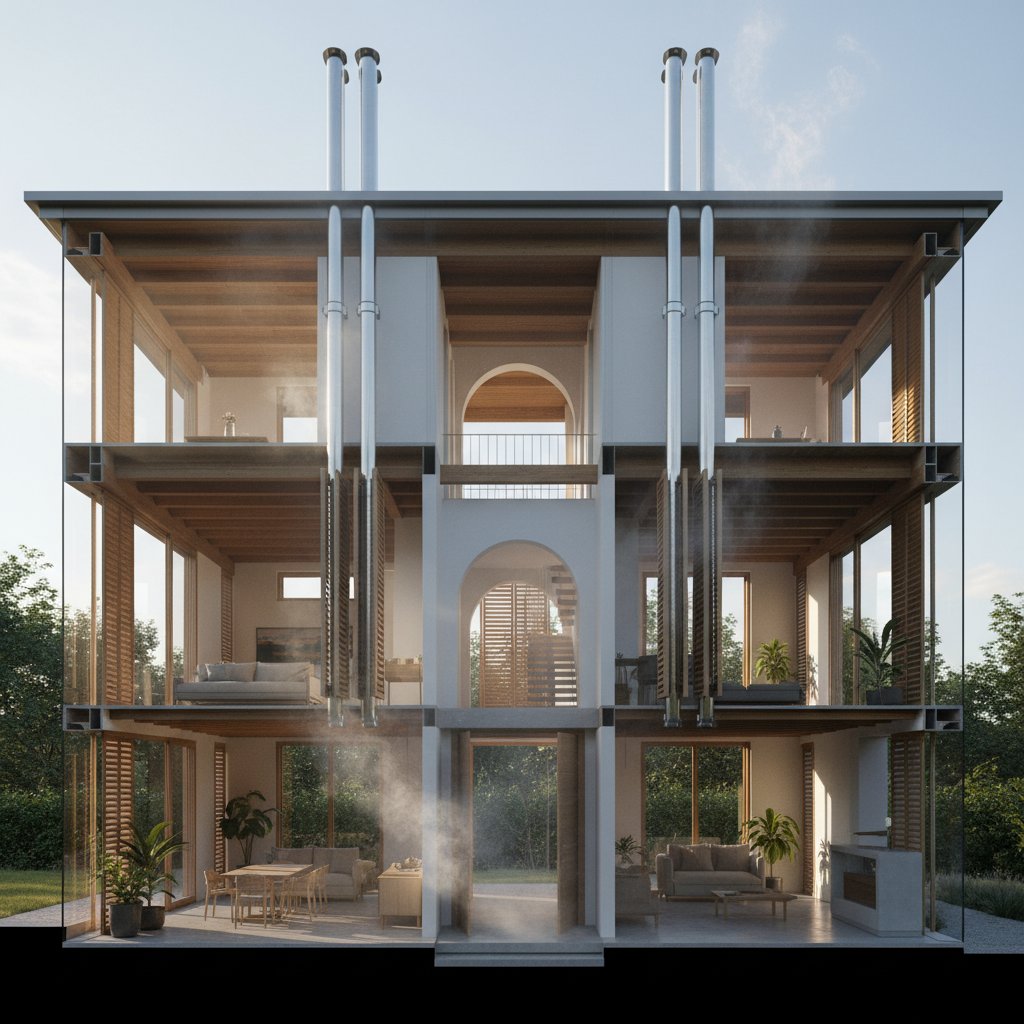
My neighbor spent $8,000 on a new HVAC system last summer. Meanwhile, I was sitting comfortably in my 68-degree living room with nothing but cross-ventilation and some strategic design choices doing the heavy lifting. The look on his face when I told him my cooling costs? Priceless.
Natural ventilation isn't your grandmother's open window anymore. The game has completely changed in 2024, with new materials, smarter design principles, and a better understanding of airflow physics that actually work. Let's break down what's actually effective this year.
The Modern Playbook for Passive Cooling
1. Stack Ventilation Gets a Tech Upgrade
Hot air rises—groundbreaking, I know. But here's what's different: automated thermal chimneys now use temperature-responsive actuators that open and close vents without any electricity. Install a solar chimney on your roof (expect to pay $2,500-$4,500 for a quality setup), and you're looking at temperature reductions of 10-15 degrees Fahrenheit during peak afternoon heat.
The sweet spot is a chimney that's at least 15 feet tall with a 2-3 foot diameter opening. Paint it black on the south-facing side to maximize solar gain. That heated air creates a pressure differential that sucks cooler air through lower-level windows like a natural vacuum. I've seen this drop indoor temps from 85°F to 72°F in under 90 minutes.
New ceramic thermal mass materials released in late 2023 have changed the equation too. They absorb heat during the day and release it slowly at night when you actually want that thermal chimney working in reverse mode.
2. Night Purge Ventilation with Smart Sensors
This technique floods your house with cool night air, but the 2024 twist involves WiFi-connected window actuators that cost around $150-$200 per window. Program them to open automatically when outdoor temperature drops below indoor temperature (usually around 9 PM in most climates).
The math is compelling: if nighttime temps drop to 65°F and your house is sitting at 78°F, you can flush out that accumulated heat in 3-4 hours with proper cross-ventilation. Pair this with ceiling fans running on low, and you're creating an air exchange rate of 15-20 air changes per hour. That's better than most mechanical systems.
One caveat—you need thermal mass inside the house to make this work. Concrete floors, brick walls, or even strategically placed water features act as heat sinks that absorb coolness overnight and radiate it during the day.
3. Windcatchers Aren't Just for Ancient Persia Anymore
These vertical towers that capture prevailing winds and direct them into living spaces have been redesigned with modern aerodynamics. Companies like Monodraught now make residential windcatchers that look architecturally intentional rather than like you bolted a chimney on sideways.
A properly oriented windcatcher can generate air movement at 400-600 cubic feet per minute without any mechanical assistance. Position it perpendicular to your dominant wind direction (check historical weather data for your zip code—this matters more than you'd think).
Installation runs $3,000-$6,000 depending on size, but the payback period is roughly 4-6 years in hot climates where you'd otherwise be running AC from May through September. Plus, unlike AC, these things last 30+ years with basically zero maintenance.
4. The Courtyard Configuration Makes a Comeback
Open floor plans are finally dying, and good riddance. Creating a central courtyard or atrium—even a small 10x10 foot space—generates a microclimate that's typically 5-8 degrees cooler than the surrounding house. The key is having openings at both ground level and ceiling height to create that vertical air movement.
You don't need a mansion for this. I've seen 1,200 square foot homes cleverly designed with a small internal courtyard that acts as the lungs of the house. Add some shade-loving plants and a small water feature, and you've created an evaporative cooling engine that runs on physics alone.
The 2024 innovation here is using polycarbonate roofing panels that block 99% of UV but let in diffused light. This keeps your courtyard bright without turning it into a greenhouse.
5. Operable Walls and Adjustable Thermal Envelopes
Fixed walls are so 2020. The latest approach involves sections of exterior walls that can be opened completely—think giant garage doors made of insulated panels. During cool mornings and evenings, you're essentially turning your house into a pavilion. When heat peaks, close everything up and let your thermal mass do the work.
These systems aren't cheap—figure $8,000-$12,000 for a 12-foot wide installation—but they fundamentally change how your house interacts with outdoor conditions. You're no longer fighting the climate; you're working with it on your own terms.
Combine this with external roller shades (the good ones cost $400-$600 per window but block 95% of solar heat gain), and you've got a dynamic system that adapts throughout the day.
6. Bernoulli's Principle Applied to Window Placement
Here's the physics lesson that actually matters: air moving past an opening creates negative pressure that pulls air out. Position windows on opposite walls at different heights—intake windows low on the windward side, exhaust windows high on the leeward side—and you've created a natural air accelerator.
The magic ratio is 1:1.25 for intake versus exhaust area. So if you've got 20 square feet of intake windows, aim for 25 square feet of exhaust openings. This creates a venturi effect that can increase airflow velocity by 30-40% compared to equal-sized openings.
Most architects still get this wrong, treating all windows as equal. They're not. Strategic placement based on prevailing winds beats random window distribution every single time.
The Reality Check
Look, natural ventilation won't work everywhere. If you're in Phoenix during a 115°F heat wave, you'll need some mechanical backup. But for the 70% of the US that experiences moderate summers, these strategies can eliminate or drastically reduce AC dependence.
The upfront costs range from $5,000 for basic improvements to $25,000 for a comprehensive passive cooling system. Compare that to running central air conditioning at $200-$400 per month for six months, and you're looking at a 3-7 year payback period. After that? Free cooling for decades.
My house stays comfortable through 90°F days without touching a thermostat. That's not magic—it's just physics, good design, and being willing to work with nature instead of against it.